07/07/2021 issue

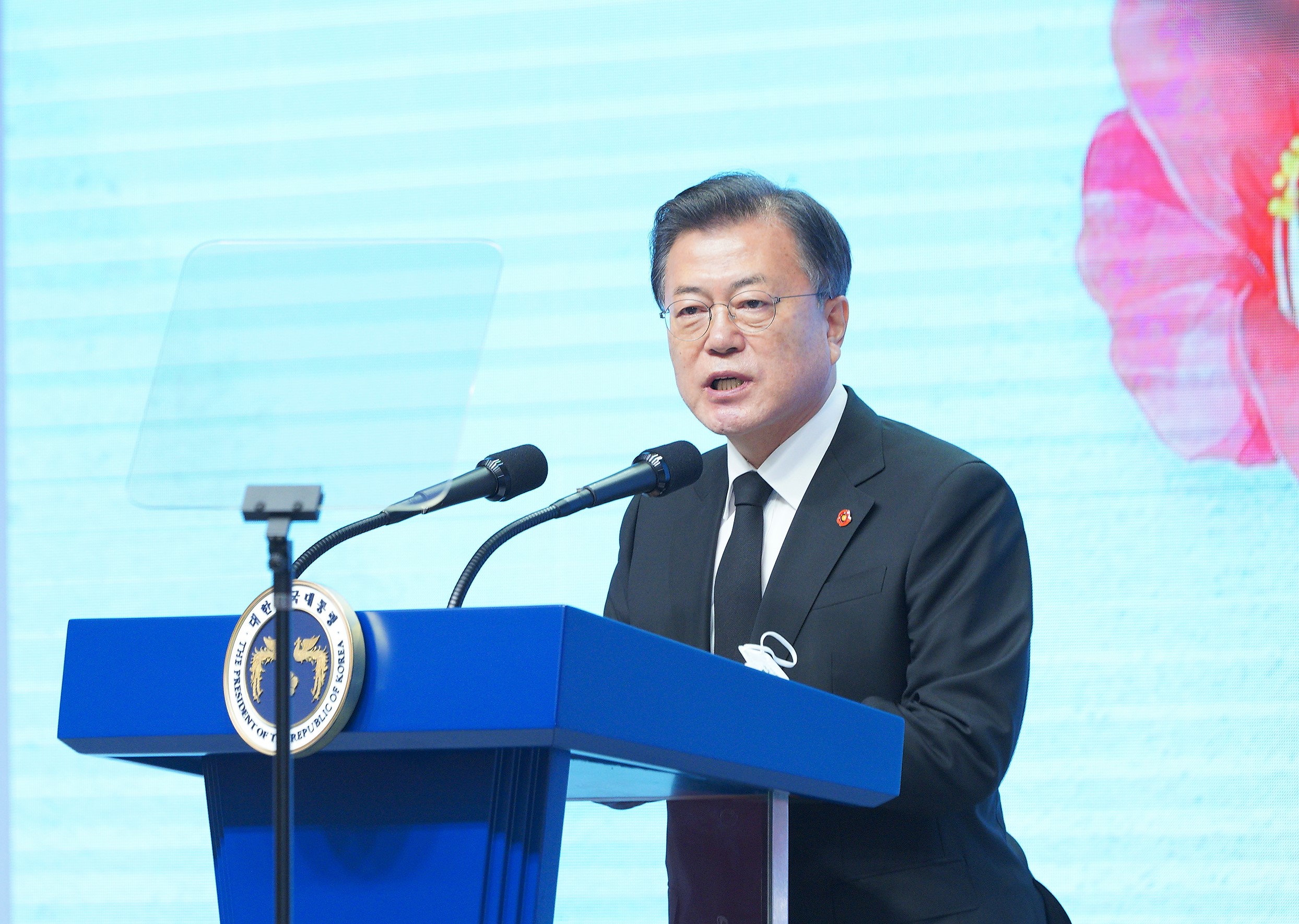
Remarks by President Moon Jae-in at Memorial Ceremony to Honor Victims on 73rd Anniversary of Jeju April 3 Incident

Remarks by President Moon Jae-in at Memorial Ceremony to Honor Victims on 73rd Anniversary of Jeju April 3 Incident

April 03, 2021
 

Fellow Koreans, surviving victims and bereaved families of the 1948 Jeju April 3 Incident, residents of Jeju-do Province,


On this memorial day to honor the victims 73 years after the April 3 Incident, spring rain is falling across Jeju Island. I am standing here with a sincere wish that the pain of surviving victims and bereaved relatives will be washed away by the rain.

Also joining me are the Minister of National Defense and the Commissioner General of the Korean National Police Agency. It is the first time for the heads of the military and police to attend an official government memorial ceremony for the Jeju April 3 Incident. This should have happened earlier, but their attendance carries special meaning as it symbolizes a first step. I hope that the surviving victims, bereaved families and residents of Jeju-do will accept the sincere apologies from the military and police in the spirit of tolerance and reconciliation. Their apologies represent the Government’s commitment to reflect on the history of state violence more deeply with introspection. I hope that the suffering of bereaved relatives can be alleviated, albeit slightly. Together with the people, I pray that the souls of the April 3 Incident victims can rest in peace.

It is an immense relief that I can report to you today that the Special Act on Discovering the Truth of the Jeju April 3 Incident and the Restoration of the Honor of the Victims has been amended. The revised law now contains measures to uncover more truth as well as to restore the victims’ honor and support those sacrificed due to state violence. The revision to the Special Act can now shed light on the truth behind the Jeju 3 Incident. The horrible deaths that Jeju islanders had to suffer and the ensuing multi-layered constraints that were imposed upon them must be fully revealed. Only then will the April 3 Incident, which arose from Jeju’s desire for a better country, be able to find the place it deserves in history.

The revised Special Act provides a blueprint to build a home for the history of the Jeju April 3 Incident. We still have a long way to go, but I promise that we will delicately refine and faithfully implement that blueprint which embodies the aspirations of the souls of the April 3 Incident, surviving victims, bereaved families and the people.

Fellow Koreans, residents of Jeju-do,

Two undercurrents flow within the history of the Jeju April 3 Incident. One represents the most painful tragedy of Korea’s modern history in which state violence assaulted people’s lives and human rights. The other represents a history of recovery and mutual benefit aimed at peace and human rights.

The state authorities at that time mercilessly suppressed Jeju residents and drove many to their deaths, branding them as “Reds,” “rioters,” and “rebels” amid charges that they envisioned complete independence and opposed national division. Victims were turned into perpetrators. The military dictatorial regimes used repression and a guilt-by-association system to drown out even the voices of the victims.

However, the Jeju April 3 Incident was never mired in confrontation and sorrow. The surviving islanders tried to regain spring through their own efforts, embracing and caring for each other. They addressed the conflicts with the spirit of reconciliation and unceasingly moved forward toward peace and human rights.

Those who lost everything without a single household item left eked out a living by earning money through the help of neighboring villages. Carpenters lent out their skills, so they could rebuild their homes.

Children who lost their parents were raised by close relatives and neighbors, and the whole village pulled together to carry out major tasks like gathering firewood, plowing dry fields, observing memorial services, holding weddings and building schools. Those who left to live on the mainland and even those who went to other countries sent goods and money to help the people who stayed in their hometowns.

They raised each other up through the spirit of mutual benefit, and finally they were able to bring out the truth of the Jeju April 3 Incident. For the first time in half a century, the taboo surrounding the incident was lifted, and the Kim Dae-jung Administration paved the way for ascertaining the truth and restoring the victims’ honor. This came about thanks to those who summoned the courage to continue their testimonies and take action. In 2003, the Roh Moo-hyun Administration confirmed a government-level fact-finding investigation report. For the first time in history, President Roh Moo-hyun made an official apology to the bereaved families and Jeju residents for the state authorities’ past misdeeds. And, my Administration was able to draw one step closer to the truth of the April 3 Incident. All of this is also attributable to the residents of Jeju and our people, who have long moved forward unwaveringly step by step together with their neighbors.

The revision to the Special Act this time was made possible because all those living joined hands to set the April 3 Incident right in history. A total of 124 institutions and organizations, including Jeju Special Self-Governing Province, its Provincial Council and Office of Education, as well as Jeju residents from various spheres – religious communities, students and political parties – have pulled together with a single goal in mind by launching a joint effort to secure this revision.

The Governors Association of Korea, the Association of Metropolitan and Provincial Council Chairs and the National Council of Governors of Education have voiced consent for the revision of the Special Act. In addition, metropolitan and provincial councils nationwide adopted resolutions to urge the revision, thereby assisting Jeju residents with achieving their long-cherished wish. The National Assembly also joined forces in a bipartisan manner. The revision of the April 3 Special Act, which was agreed upon by the ruling and opposition parties, will be regarded as one of the greatest achievements of the 21st National Assembly. I would like to take this opportunity to express my profound gratitude and respect to all of those from every walk of life who worked together for the revision.

Fellow Koreans and Jeju residents,

The revision this time paved the way for 2,530 former inmates imprisoned by a military court in 1948 and 1949, to regain their honor through a collective retrial. Already in 2019 and last year, two retrials acquitted 25 surviving former prisoners of their charges, freeing them from the yoke that has been on them for 70 years. On March 16, 333 missing prisoners and two surviving prisoners convicted during a general trial were found not guilty in retrials.

Following murderous interrogations and torture, they went through trials where names were read out as mere formalities and had to live with the stigma of being criminals for over 70 years. Young boys were only found “not guilty” after having grown to be over 90 years old. Special retrials for 2,162 people who lost their relatives and were deprived of honor and dignity, hometowns and dreams still remain. The Government will continue to fulfill its national responsibility by returning those things which were deprived by state violence, albeit slightly, after ascertaining the truth about each and every person, restoring their honor and providing them with reparations and compensation.

Nothing can resolve all the sorrow that has passed, but the Government will do all it can to not only further investigate the truth but also implement follow-up measures to restore the honor of those imprisoned. We will do everything possible to put fair and reasonable standards in place for compensation and reparations as well. Even now, there are many bereaved families anxious about their missing relatives. Some 275 of the 408 people whose remains have been found so far, including the three who were unearthed in Gasi-ri a few days ago, have not yet been identified. Along with the project to exhume the remains, the Government will support DNA identification in a bid to ensure that the deceased are returned to their families without fail.

Since last May, the 4·3 Trauma Healing Center has been operating on a trial basis, and more than 12,000 people visited during the first nine months since its opening. It is rewarding, though belated, that elderly victims and bereaved relatives can bring back memories of that day they have tried not to recall and find closure for their pent-up agony. I am profoundly grateful to those involved in running the Jeju 4·3 Peace Foundation and the 4·3 Trauma Healing Center, who have worked hard to heal the hearts of the wounded. Once the relevant laws are enacted, the Government will upgrade it to a national trauma center and provide support to ensure that the pain felt by many people can be healed entirely.

Fellow Koreans, surviving victims of the Jeju April 3 Incident, bereaved families and Jeju residents,

In the Jeju 4·3 Peace Memorial Hall inside the Jeju 4·3 Peace Park, an unmarked stele still lies on its side. The 73rd spring has come to Jeju-do since the tragedy, but the April 3 Incident still has a long way to go. We do not know what name will ultimately be carved on the stele, but it is clear that the truth uncovered will become a driving force that leads us toward unity, and the honor restored will guide us toward a greater harmony and mutual benefit as well as peace and human rights.

Let us all join hands more tightly until a full-fledged spring finally arrives on Jeju.

Thank you.

07/07/2021 Events

The 73rd Memorial Ceremony for the Victims of Jeju 4·3

[Special Report] The 73rd Memorial Ceremony for the Victims of Jeju 4·3

Spring after 73rd Jeju 4·3 Memorial Brings Condolences to Victims
[On-the-ground] President, Defense Minister, Police Chief Attend


Article by Jeju 4·3 Peace Park Editing Team
Photographs by Cheongwadae, Jeju Provincial Office


The spring of the 73rd Jeju 4·3 memorial brought condolences to those who have suffered since the tragic turmoil swept over South Korea’s southernmost island of Jeju. The nation’s COVID-19 situation showed no improvement from last year. This kept at home the bereaved families of the victims, who had expected to be able to attend the memorial ceremony this year.

President Moon Jae-in unexpectedly attended the memorial ceremony for a second consecutive year. His attendance coincided with the National Assembly passing the revised bill on the Jeju 4·3 Special Act on Feb. 26. The president, who had originally pledged to attend the ceremony biennially while in office, stood with respect in front of the souls of the deceased. With his exceptional presence at the event, Moon provided warm consolation to those Jeju people, including victims’ families, who were unable to make it to the ceremonial site.

On April 3 when spring rain drizzled upon the Jeju 4·3 Peace Park, the victims’ families were able to participate in the memorial ceremony by watching it live on television or through the Internet


Presidential revisit to memorial ceremony, following the passing of the revised Jeju 4·3 Special Act

The 73rd Memorial Ceremony for the Victims of Jeju 4·3, hosted by the Ministry of the Interior and Safety and the Jeju Special Self-Governing Province, was solemnly held on April 3, at the Jeju 4·3 Peace Education Center.

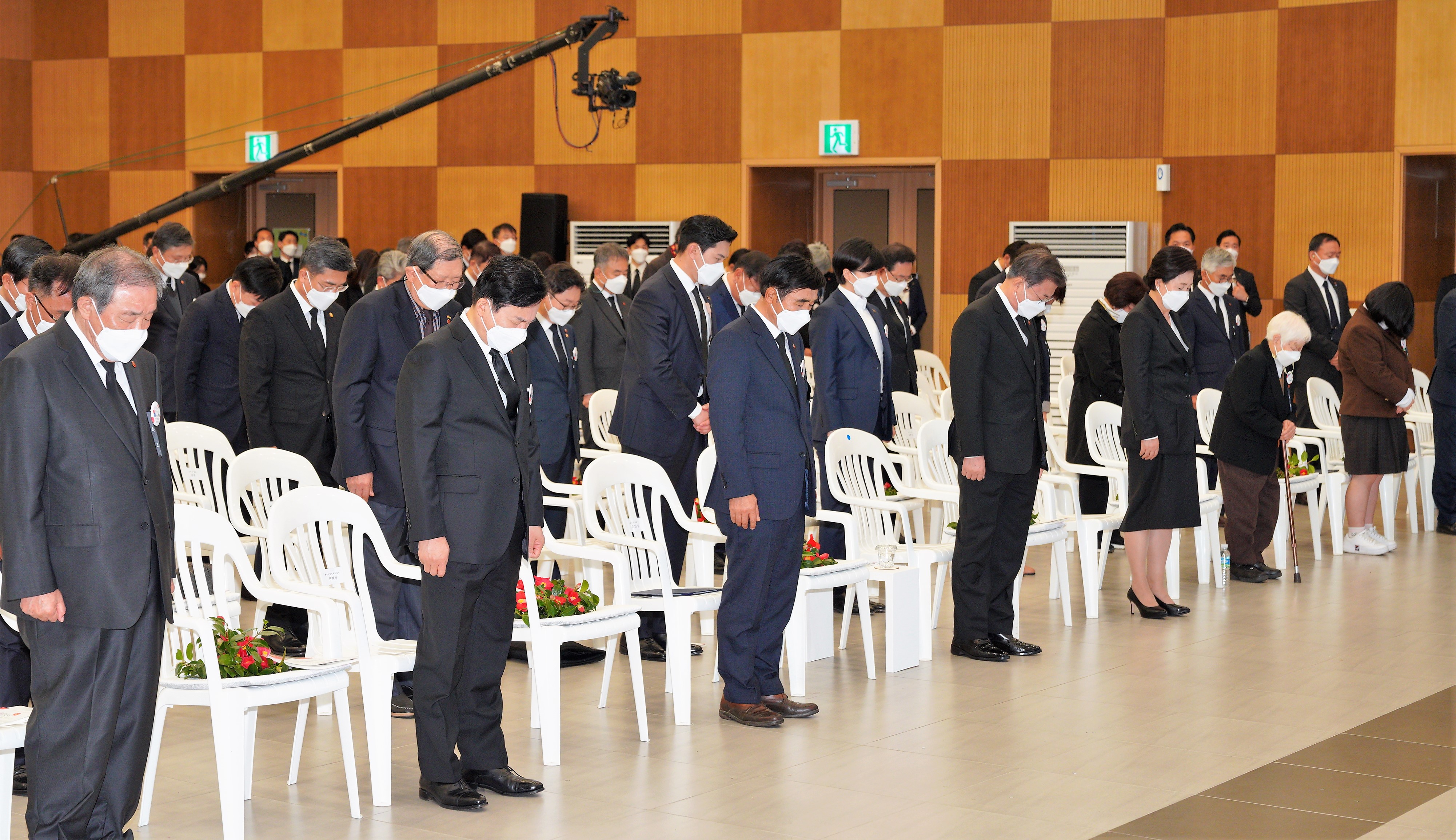
The ceremony was held indoors due to rain, while the social distancing rules in place to prevent the spread of the COVID-19 pandemic reduced the scale of the event to fewer than 70 participants, the smallest number of people ever in attendance. The distinguished attendees featured Moon accompanied by first lady Kim Jung-sook. Minister of Defense Gen. Suh Wook and the Commissioner of the National Police Agency Gen. Kim Chang-yong also attended the memorial ceremony on behalf of the nation’s constabulary forces, marking the first time the nation’s military and police heads participated in the memorial event.

The bipartisan list of participants included: Rep. Kim Tae-nyeon, floor leader of the ruling Democratic Party of Korea; Rep. Joo Ho-young, floor leader of the main opposition People Power Party; and Rep. Yeo Young-guk, floor leader of the minor opposition Justice Party. Other high-level officials also attended the event, including: Park Beom-kye, minister of Justice; Jeon Hae-cheol, minister of the Interior and Safety; and Jung Geun-sik, president of the Truth and Reconciliation Commission. Last but not least, the local delegation included: Won Heeryong, governor of the Jeju Special Self-Governing Province; Oh Im-jong, chairman of the Association of the Bereaved Families of Jeju 4·3 Victims; Yang Jo Hoon, president of the Jeju 4·3 Peace Foundation, and other members of the related institutes and organizations.

The memorial ceremony began at 10 a.m. with a siren sounding for one minute in every corner of Jeju Province, requesting a silent tribute to be paid to the Jeju 4·3 victims. The event then proceeded with the screening of a video, the pledge of allegiance and ceremonial salute to the national flag, the recital of a memorial poem during the silent tribute, the screening of the memorial documentary “Traces of Documentation,” the memorial remarks by President Moon, the introduction of a victim’s family, and the memorial performances.


President fully commits to take ensuing measures of the Revised Jeju 4·3 Special Act
Acknowledges Foundation and Trauma Healing Center for healing wounds incurred by victims’ families

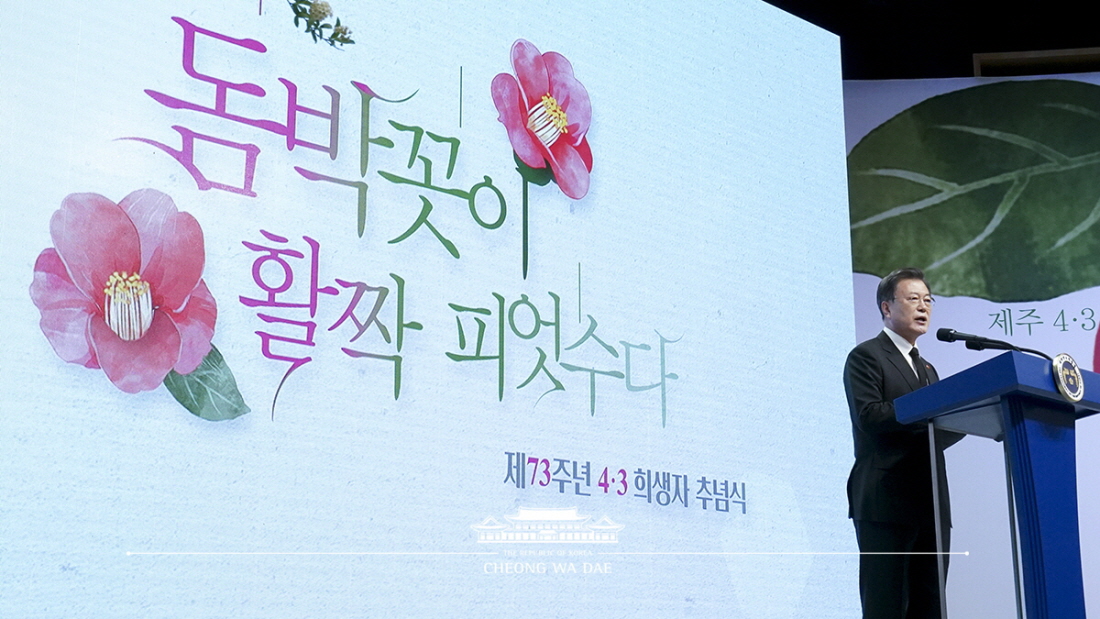
In his memorial speech, President Moon expressed “a sincere wish that the pain of surviving victims and bereaved relatives will be washed away by the rain,” while stating that “it is an immense relief to be able to report on the amendment of the Jeju 4·3 Special Act.” The president admitted that “we still have a long way to go,” but promised to “delicately refine and faithfully implement the blueprint, which embodies the aspirations of the souls of those who lost their lives due to Jeju 4·3 and their bereaved families, those who survived Jeju 4·3, and all the other fellow Koreans.”

Moon expressed his gratitude to all those in and out of Jeju Province who have put forth efforts to secure the revision. The president also acknowledged the Jeju 4·3 Peace Foundation and the 4·3 Trauma Healing Center for their efforts to heal the wounds inflicted upon the victims and their families. 

“I am profoundly grateful to those involved in running the Jeju 4·3 Peace Foundation and the 4·3 Trauma Healing Center who have worked hard to heal the hearts of the wounded,” he said. 

He also promised that once the relevant laws are enacted, “the government will upgrade [4·3 Trauma Healing Center] to a national trauma center and provide support to ensure that the pain felt by many people can be healed entirely.”

The presidential address was followed by the silent tribute paid to the victims. During the silent tribute, Chairman Oh Im-jong of the Association of the Bereaved Families of Jeju 4·3 Victims recited the memorial poem “Until when our 4·3 is remembered as a warm spring day,” written by Jeju-born poet Kim Su-yeol. The screening of the memorial documentary was performed concurrently with another poem recital by Go Doo-shim, South Korea’s established actress from Jeju Island, who read “While you had a mournful spring,” written by Heo Young-sun, director of Jeju 4·3 Research Institute. The introduction of a victim’s family featured Ko Ga-hyeong, a first-year student at Daejeong Girls’ High School and the 17-year-old granddaughter to Son Min-gyu, 87, whose parents and elder brother died during the social unrest surrounding Jeju 4·3. Son’s brother went missing while serving his sentence in the Daegu prison after being convicted by a court-martial. The March 16, 2021, retrial held by the Jeju District Court acquitted him of his false charges.


President Moon Jae-in commits to take ensuing measures of the Revised Jeju 4·3 Special Act.


“Grandma, you said the pent-up sorrow finally started to be relieved,” Ko said. “Now, let me heal the pain left for you. My dream is to become a psychotherapist so that I can offer comfort and help to those who have been hurt in their hearts just like you. I’ll make sure to ease all of your deep sorrow. So you must stay healthy until then. I love you, grandma.”

Son sobbed listening to her granddaughter introduce her story. After Ko’s speech, the president and the first lady offered them words of consolation and encouragement.

The official memorial event ended with South Korean band Sweet Sorrow singing “A Blue Day,” which was originally composed and performed by Song Chang-sik.


Distinguished guests pay silent tribute to the souls of the Jeju 4·3 victims.


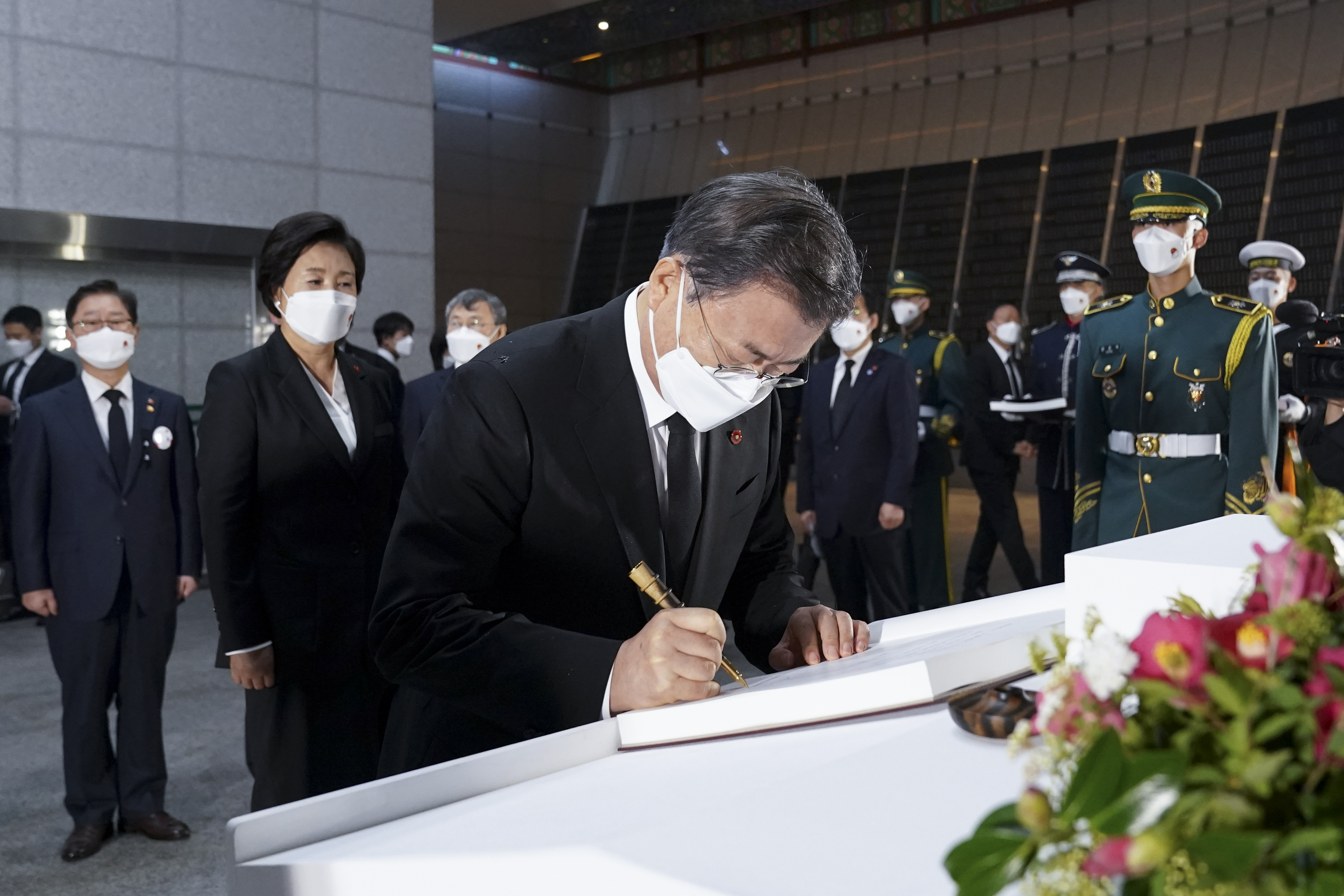
President Moon Jae-in signs the Revised Jeju 4·3 Special Act in the Memorial Tablets Enshrinement Room of the Jeju 4·3 Peace Park.


Presidential signing ceremony reminiscent of 21 years ago

Immediately following the memorial ceremony, the president and the first lady visited the Memorial Tablets Enshrinement Room of the Jeju 4·3 Peace Park. The heads of state burned incense and laid white chrysanthemum and camellia flowers on the altar for the deceased, while being escorted by the guards of honor of the nation’s Ministry of Defense. During the presidential floral tribute and incense burning, Lee Ha-eun, a first-year student of Jeju Dong Middle School, sang “Spring in Jeju” to the harmonica tune of “Spring in My Hometown,” which was performed by South Korean pop musician Hareem.

The memorial tribute was followed by the ceremony of President Moon signing the Revised Jeju 4·3 Special Act. The ceremony was also attended by: Justice Minister Park, Defense Minister Suh, Interior and Security Minister Jeon, National Police Agency Commissioner Kim, Truth and Reconciliation Commission President Jeong, Jeju Gov. Won, Association of the Bereaved Families of Jeju 4·3 Victims Chairman Oh, and Jeju 4·3 Peace Foundation President Yang. A total of seven bills concerning the revision of the Jeju 4·3 Special Act and its Enforcement Decrees had been compiled into a book that President Moon signed during the ceremony.

President Yang of the Jeju 4·3 Peace Foundation had also attended Kim Dae-jung’s signing event after the special law was enacted in 2000. 

Yang reminisced: “The 2000 signing inspired hope around Jeju 4·3, which had been seemingly an insoluble issue of Korea’s dark modern history.”

The latest revision is “greatly significant” as “the bill was passed based on a bipartisan consensus just like in 2000,” he said. 

The 4·3 expert said he hopes “the efforts to resolve the Jeju 4·3 issues will move forward to the restoration of honor to the victims and the healing of the suffering of the victims and their families, and eventually build an exemplary model of resolving the past wrongdoings in history.”

Meanwhile, Jeju Province ran a virtual memorial exhibition hall on the provincial website for those who were unable to attend the on-site memorial ceremony.


Families pray against rain and wind for those lost 

The rain from the night prior that hit the island continued throughout the day of the memorial ceremony. Umbrellas were hard to open, and the participants had to walk while clutching their raincoats against the elements. Even the unrelenting rain, however, could not stop families from visiting the Jeju 4·3 Peace Park early in the morning of the memorial day.

Those who arrived at the Tombstone Park for the Missing found the memorial stones engraved with the names of their missing family members. Despite the rain, they took out fruit, fish, and alcoholic beverages they had brought as offerings and arranged them properly before performing an ancestral ritual. Hyeon Mal-ok, 75, vowed to honor her missing father and informed him of his acquittal. 

“You are no longer guilty,” she said. “May you rest in peace. Just rest in peace.” 

The short epitaph on the tombstone says her father was named Hyeon Sang-gu and his address was registered in Odeung-ri, Jeju-eup, and that he disappeared around July 1950 in the Yeongnam region on the Korean mainland. The last scene of her father that Mal-ok remembers is seeing him from behind while he was being taken away by some unknown men. Later, her father went missing for good, but not before sending his family a postcard from the Daegu prison that said he would soon return home. He was included in the list of the 333 missing people who had been convicted by courts-martial and were acquitted by the Jeju District Court on March 16, 2021. Now, the harsh 73 years have passed since Jeju 4·3 broke out.

During a brief respite of the rain, a rainbow appeared above the graveyard for the missing victims of Jeju 4·3. The rainbow seemed to embrace the souls of the lost, as if consoling the victims and their bereaved families.


07/07/2021 issue

Declaration of solidarity for peace and human rights

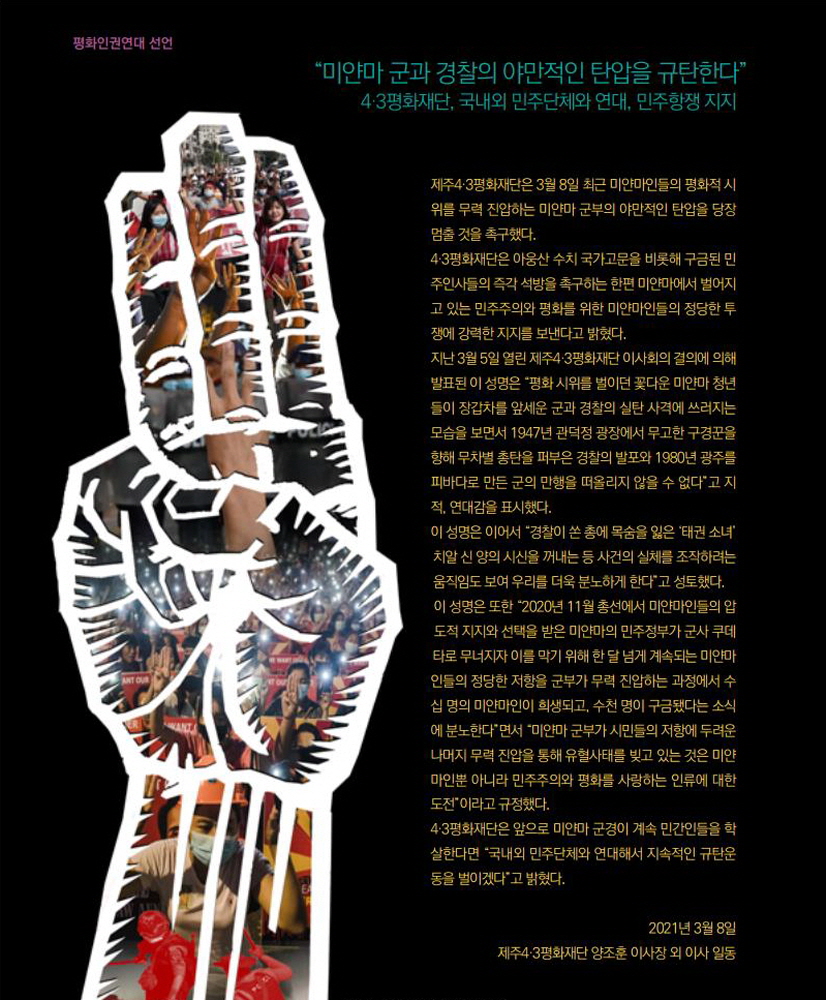
“We denounce the barbaric oppression of Myanmar’s military junta and police forces”

Jeju 4·3 Peace Foundation stands in solidarity with democratic movements at home and abroad


The Jeju 4·3 Peace Foundation urged Myanmar’s military junta on March 8 to cease its barbaric oppression actions against its citizens’ peaceful protest in opposition to the Feb. 1 coup.

The Foundation demanded for the immediate release of detained democratic figures, including Aung San Suu Kyi, state counsellor of the Republic of the Union of Myanmar, and announced that it strongly supports the struggles of the people of Myanmar for peace and democracy.

This statement was announced following the Foundation’s board of directors unanimously approving the resolution on March 5, which said, “The scenes of the peaceful resistance of young Myanmar citizens who fell under the firing of constabulary forces, armed with tanks, remind us of the 1947 police shooting of innocent civilians at Gwandeokjeong Square in Jeju and the 1980 brutal military crackdown that turned Gwangju into a city of bloodshed.”

The statement also condemned the treatment of 19-year-old taekwondo instructor Kyal Sin.

“What infuriates us more is that the police authorities allegedly attempted to manipulate the truth by exhuming the body of Kyal Sin, a 19-year-old taekwondo instructor who was shot to death by the police during the protest.”

The statement continued: “The democratic government of Myanmar won the November 2020 general election with a majority vote but was overturned by the military coup. Then the military junta killed dozens of citizens and confined thousands more during its armed suppression of the people’s legitimate resistance against the coup for over a month. This is truly outrageous.”

In the statement, the Foundation said “the suppression by force of arms and the resulting bloodshed by the military junta, terrified of the people’s resistance, is not only a challenge to the people of Myanmar but also to all of humanity who root for democracy and peace.”

The statement ended with the Foundation’s commitment to the people’s struggle, which they said would grow into “a persistent condemnation campaign in solidarity with democratic groups at home and abroad” if the Myanmar constabulary forces continue to kill civilians.

March 8, 2021

Director Yang Jo Hoon and the board of directors of the Jeju 4·3 Peace Foundation